


| |
|
|
|
|
|
|
|
|
|

 |
|
 |
|
 |
Autechre.ENGLAND'S AUTECHRE HAVE TO BE ONE OF THE MOST OVER-ANALYZED RECORDING ARTISTS OF THE ELECTRONIC ERA, THEIR EVERY BLIP AND SQUEAK MINUTELY DISSECTED FOR ITS IMPORTANCE. XLRBR PRESENTS A MORE RELAXED VIEW OF WHAT THE DUO IS ABOUT. SPLIFFS ANYONE? WORDS HERTH K. HIGNIGHT IMAGES JEREMY WEISSSHOTGUNS "I wonder-have they ever fired shotguns?" queries Eric Heinroth. "You know, it would be kinda cool to take them to my parents' ranch and blow stuff up." Daniel De Los Santos is intrigued. "Yeah! I've got some old computer cases, hard drives and monitors we could waste!" I'm sold. Autechre: the Double-Barrel Interview. BAD NEWS The bad news comes as swiftly as the word that Autechre were gracing our shores for a quaint tour: Sean Booth and Rob Brown were being surly with the journalists. Shit. And this, my first chance to talk to them in person. The chance that countless fanboy-turn-journalists have sought, the wet dream of every would-be (and many established) computer programmer-cum-musician, the money-shot of every IDM list member who's not crawled far up his own pimply ass in search of Cooler Than Thou-dom. The opportunity loses a bit of its lustre with Sascha Kosch's De:Bug interview in Berlin, fatefully dated May 1 st, in which Messrs. Booth and Brown avoid the obvious questions: DeBug: Where is Autechre going with this next album? Sean: Nah. Nah nah. DeBug: Not a specific... Sean: No. Not because we didn't have anything specific in mind when we did the tracks. I don't want to pretend now that we've got something. Shit shit. Are they surly because they're so full of themselves for being Warp's ace-in-the-hole act? Because, like the Orb's Alex Paterson, they'll always sell at least 10,000 copies of anything they release? Because they can command any price they want for a remix? What do I do?
De Los Santos and Heinroth-both of Mad Monkey Records and
ever-present conspirators in friendly 10M ballyhooing-are as stumped
as I. Autechre are up for just about anything, I'm told by the
publicist, as they've not visited Austin prior.
"Why don't you take
them up to Mount Bonnell? That's a nice, scenic spot," suggests De
Los Santos, long an Autechre admirer but a little nonplussed with
their work of late. Quiet as he always is, Heinroth agrees. "Let's
check it."
The three of us take the ten-minute drive outside of
Dubya's old stomping grounds into the skirts of the hill country and
make our way up the winding curves of Mount Bonnell's white-cragged
rocks. On top and looking west over the Colorado River, we see the
lavish houses, big boats on Town Lake, and manicured lawns of
Central Texas's nouveau riche. To the east, the distance holds
Austin's meager skyline, while the immediate attraction is the
waste-water treatment facility just off the foot of this (ha ha)
mountain.
"But these guys have played at Mount Fuji!" I exhort. How
can I take the two people who, for the last decade, have defined the
purest joys of electronic listening music, up this lousy stump? How
can I ask them the deepest, darkest secrets of their creative
process while watching shitwater rinsed clean? I wonder-have they
ever fired shotguns?
BEAR ARMS I'm anxious upon my arrival at Autechre's hotel, as their tour manager, Mark Parsons, said they weren't into shooting guns-because they thought it also would be a photo shoot. And as he calls Booth and Brown to come down to his room so we could meet, he mentions that I should explain to them exactly what I have in mind and see what they say.
They come in and right away discuss the
merits of bearing arms. Brown hides his approval of blowing things
up with shotguns behind a suppressed smirk, especially when I tell
them that we'll be shooting at peripherals, monitors and other
assorted computer equipment. Booth's not unamused by the idea
either, but nevertheless plays devil's advocate, true to form with
what my journalistic colleagues have told me about their attitude
thus far:
"I don't particularly like the idea of destroying stuff
just to destroy it."
"We could do much better to give it to someone
who needs it, who could use it."
"There are problems with us being
associated with guns." Brown counters each, but in the end it's
Booth's call: when in Texas, Autechre will not necessarily do as
Texans do.
BACK IN THE USSA I suggest we get something to eat and figure out what to do after that, and' the duo perk up a bit. Being vegetarians, they opt for Mother's, a respected . hippy dive with an ivied garden outside. On the way, Booth and Brown begin asking the questions that any first-time visitor might ask: about Austin, what residents think of our new president, and whether anyone here cares that his family are energy moguls. They're keenly interested in understanding something about the town, as though they can't believe they're in a place that tolerated such ignorance.
It's grossly
apparent that the last thing on Autechre's mind is talking about the
consequences of their recently released sixth album, Confield.
Austin represents the last leg of a two-month tour where every
journo jumping the "underground" bandwagon has implored Warp's new
US office for interviews. As such, they're enduring the same
repeated speculative questions about musical philosophy and
mechanics along with other generically "deep" queries: "Your
increasing use of software signals a change in how electronic music
is being made. How do you feel about that?"; "LP5
and Chiastic Slide
were a breakaway from making 'songs' and a striking move toward
experimentation. Why did you do that?"; "How do you choose your
remix projects?"; "What do you think of your new album?"
Considering
the tiresome nature of such affronts, it's easy to see how they
might be sick of this entire process. We venture back to the
vegetarian issue when the menus arrive, and Booth explains his
position. "I actually stopped eating meat the last time I was in the
US... the meat I was getting was so terrible, it didn't taste right
at all. I'm not on it for some moral issue." I convey that I don't
get the moral issue either, and he and Brown both chime in, rather
vehemently.
"Right, what the fuck are people on about? It's not
different at all," exclaims Booth.
Brown is a bit more diplomatic
and, in his tone, less overtly emotional. IIWe know for a fact that
in the process of killing a plant, information is relayed to the
different parts of the plant through chemical interactions. The
plant is, in a chemical sense, aware of the fact that it has lost a
limb, lost a fruit, or lost everything above its root structure, or
that it has been removed from the earth. Like humans, like animals,
chemical changes and information are passed through the plant as a
response. Whether [or not] they can feel it is not the issue;
it's invasive, and it happens before the plant intends or would
otherwise have died on its own. We have to accept that."
"Right,
and in a sense, plants feed on us," Brown continues. "When we die,
they are sus tained from the materials in the earth, which is where
all of us end up. In the end, they win, if in fact there's something
to be won." And with that, he shoves a plant carcass into his mouth.
POINT-COUNTEROINT If the conversation to this point illustrates nothing else, it's that Brown is yin to Booth's yang. The duo's symbiotic yet complimentary conversation style reflects a musical collaboration that has progressed so far beyond spoken exchange, beyond friendship and mutual respect, beyond the need to explain themselves to a journalist like me, that they talk as though they're of the same mind. Together Booth and Brown are the monster Autechre, and today, the monster could not care less about the impact Canfields anti-song sound constructions might have on legions of laptop jocks. Instead, what they're on about is a little rest, a little respite from the hurry-up-and-wait mode of touring... and a little weed. Parsons had clued me in to this right away inside the hotel room: "Yeah, they're needing some."
After we leave Mother's,
Sean brings it up in the car. I tell them we can find what they ,
need back at my house. And would they like to just chill there for a
bit, relax, and talk a lit tle instead of heading to the show venue?
"Definitely," they remark in stereo.
IT'S IN THE MAIL We hit my house about the same time as the mail carrier, who dumps boxes and envelopes on my doorstep with a grimace. The sheer volume of promotional material prompts Booth to muse about wasteful business processes like bulk mail. I tally up the postage from packages bearing promos that day: $19.75. They guffaw.
"May we listen to some of this?" remarks Brown. "I mean,
someone paid postage for all of it!" I open a box from S//:kimo and
we go through the contents. We come across the VVM 3-inch CDs for
Help Aphex Twin vols 1.0 and 2.0, and throw them on.
As snippets of
"Ventolin," "Xtal," and "Polygon Window" whiz out of the speakers
under the torqued filters of VVM's silly mind, Brown exhales a
relaxed laugh. "I've got to play this to Richard! He's gat to know
this is out, right?"
"Gat to know!" giggles Booth like a
school-girl holding her first joint.
"See, I criticized them the
last time I saw them," Brown continues. "They go after easy
targets, but this is totally... one hundred... percent. . . the
opposite tack!"
We continue talking about the merits of such
lampooning, with analogies to Stephen Hawking acting like a parasite
for appropriating super-string theory as a component of his own
intellectual property. In making the point that such surface-focused
artistic agendas inherently hinder a work's staying power, Booth
lets slip the first mention of Canfield all day.
"I don't
particularly like much of what [VVM] do. It's like, records I've
liked, [of which] all the strength is in the narrative, I find them
really weakening after about three or four times...I can't listen to
it anymore. Probably why ours is so not like that either."
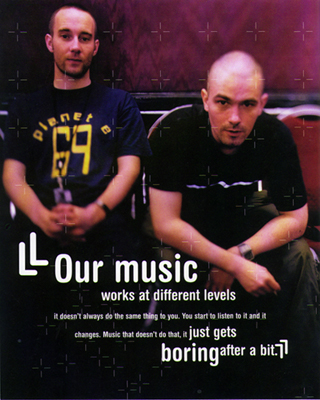
That's
Brown's cue: "Part of it is that our music works at different
levels-it doesn't always do the same thing to you. You start to
listen to it and it changes. Music that doesn't do that, it just
gets boring after a bit."
Booth continues. "I'd probably play this
about three times and then that will be it.. .unless it's got real
depth and there's something in there I can scrutinize. I mean,
Monty Python can totally change the way that you see certain things
in England if you saw it at the right time. . . and it has a
residual effect. I could watch it now and still find myself laughing
at myself for having changed to become a little bit more like them."
I tell them that I understand, and that it goes for their music,
too-I can't handle Confield on repeated listenings.
Booth grins
slyly. Like Brown, he's lost all his surliness from earlier. "Oh, I
wouldn't expect anyone to except us!"
"You'd go mad!" chuckles Rob.
"Even we're selective..."
"Yeah...we can't always tolerate it,"
says Sean. "There are loads of older tracks of ours that I dan't
want to hear right now. I'm weakened by them."
A revelation: it's OK
to not like Autechre. To not worship them as though they shit Mozart
manuscripts every time they release a remix or play live, as they do
to a slightly baffled yet packed crowd in Austin that night. It's
okay to walk away from what they played-the deep, deadpan bass stabs
that could have come from their early electro IICrystel" days and
the glaringly complex clacking patterns that plague Canfield-and
feel that it was a human music with more than a couple faults. It's
OK...they said so.
www.warprecords.com or www.autechre.nu Originally appeared in XLR8R Magazine, Issue 52. Copyright © XLR8R magazine « |
 |
|
| Copyright © 2004-08 autechre.info. | |