


| |
|
|
|
|
|
|
|
|
|

 |
|
 |
|
 |
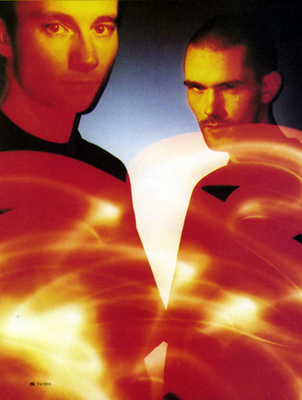
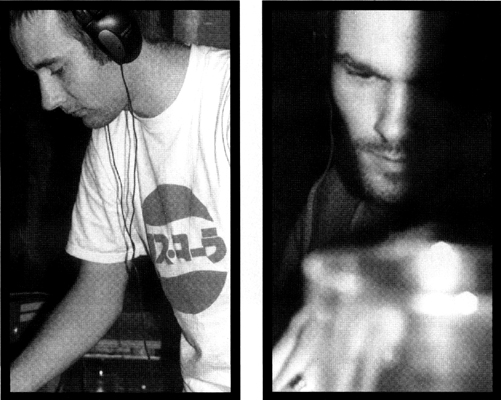
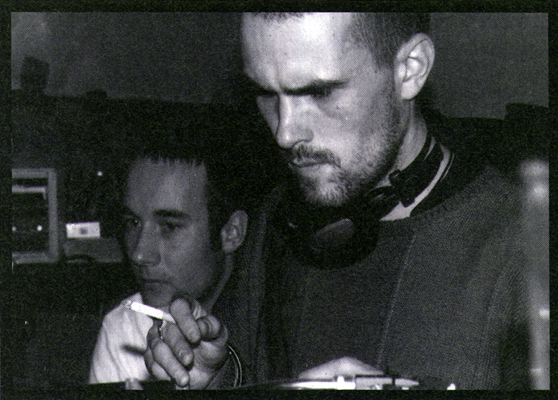
Autechre. Transformed by Sound.Via their releases on Sheffield's Warp label, the Autechre duo of Sean Booth and Rob Brown are searching out new dimensions in electronic sound. Meanwhile, their Disengage radio show has become a community news bulletin for fellow digital denizens. Interview by Rob YoungPhotos: Tim Kent Photos: Iris Garrelefs Fade In Reindeer on the streets of Sheffield: real flesh and blood reindeer, branches sprouting from their heads. A trad jazz trio materializing in and out of the crowded streets tootling Christmas tunes for the throng of happy shoppers. Music pumping from shopfronts, building sites, churches. This ain't no industrial hole: this is Disneyland. . Fade left This is where Autechre live: the road out of town, shops flogging dodgy electronics, Boatworld. Past nosy builders; iron steps; door double locked for protection. Sean Booth, grinning, brewing up; Rob Brown mucking around in Photoshop. Conversation evolves, slowly, sprinkled by a gurgling mixtape from Miami.
For the past year and a half, this small room in Booth's fiat
has been the hub of Sean and Rob's daily life: it's here they crunch
sounds around; burn tracks; absorb music from all the tapes, discs
and vinyl they collect or receive; banter and smoke with whichever
friends and associates drop by. The tools in this genial workshop
are on display: assorted keyboards old and new; a mixing desk's
studded plateau; Apple Mac; devices apparently cadged from the
army; a battered autochanger turntable used on a Kinesthesia remix
for Rephlex ("That Grundig's fuckin' hardcore", says Sean when I
spill water on it}. On this array of electronic components the pair
recorded their fourth album, Chiastic Slide, the title a cryptic
reference to the mercunal qualities of the crossfader. On the DJ
panel or the mixing board, this little
slider acts as the magician's curtain, swishing from side to side to
reveal marvels previously hidden. Only now, the way Autechre have
engineered things, the curtains have multiplied, there are boxes
within boxes, screens hiding screens hiding screens. Chiastic Slide
harbours a maelstrom of fizzing detail, smudgy beats, shredded
pulses, church organ, toxic noise hurtling towards the end of its
half-life, pumice stones rubbed across the skull. Autechre and
sound can't keep their hands off each other.
Fade right "'Disney-ality' is. . . crafted by hiding the mechanical, electrical, and labour-intensive production of the entertainments, rides, and restaurants. The dally grand parade seems to come from nowhere, fill the central plaza with dancing and music, and then simply disappear. The pomde's apparently effortless, 'magical' appearance and disappearance is central to its overall effect" - Bruce C Caron, "Magic Kingdoms" in The Sacred Mountains Of Asia Fade left "Anality's pretty cool, innit?" says Sean with a smirk. "It's got it's place. We like to dissect things, definitely I think the trick is not to let the detail become the main. .."
". . . Attraction," says
Rob, picking up the baton. "We just enjoy doing that so much. I think
we're both very easily distracted, and we'll just keep moving from
one element of the track to the next until we can't do any more.
We throw things in that are like cars with square wheels."
"It's
pretty extreme sometimes," says Sean. "It does get to the point
where you're like: how far can we take this? And it's something that
most people would think was totally finite, but we always manage to
squeeze something out of it. All the best tracks that we hear are the
sort of tracks that tweak you, by almost distracting you when you're
listening to a part of it, and then something happens and you're
forced to move around within the track."
Rob: "You're forced to
focus on different levels."
The pair's involvement in the Manchester
HipHop/tagging community in the late 80s
has been well documented (including an honorary mention in the
Manchester Constabulary's files, allegedly), and the influence of
HipHop -- its ninja aesthetics, on the-fly tactics, insistent
transformations -- remains pervasive.
"The whole idea of
transforming sound is HipHop, to us anyway," says Sean. "Taking
something that almost already exists, and doing something fresh
with it, fucking it over and doing something new, taking it
somewhere that we'd like it to be. Rather than the emphasis on it
being different for the sake of it, it's more that it's different because
we're different. We allow the fact that we don't quite fit in to be a
positive thing.
"It's about sleight of hand, where you're revealing
things and then pulling them back. It's that sort of dynamic. But I
think that's Hip Hop: the whole attitude of wanting to do people's
heads in a little bit but also give them something that they'll really
appreciate comes from that - Mantronix to early Bomb Squad ---
where there were little tricks in there, and you knew the producer
had stuck them in there because he knew it would do people's
heads in. And it'd be like: fucking hell, how did he do that? Or,
that's a totally mad thing to do with your track. But it didn't suffer
because it wasn't. . ."
Rob: "Wasn't a showcase for those ideas."
Sean: "It was part of the flow and it worked. That's it really. That's
how we've started describing it now."
Fade right "Detailed modem maps exist for all the spaces and machinery above and below ground at all the Disney parks These are reserved only for the eyes of those who engineer the Disney magic. . . Above ground the pathways within the 'Kingdom' have a centripetal, Moebius effect, always bringing the visitor back from the edge to the centre. . . The entire park feels much larger than it 'really'is (no scale is provided on the map)" - Bruce C Caron, "Magic Kingdoms" Fade left In the conventional language of music there are few maps to guide the listener around the textural chasms and plateaux of a sound such as Autechre's. It's not that it's intangible, because it seems to reach into your mental machinery and turn cogs that have lain unused since the dawn of evolution. But in the manner of all sound that inspires awe through immense, alien beauty, from AMM to Brian Ferneyhough to Sean's current favourite Tod Dockstader, there are few fixed stars to guide you through its universe. Track titles are a kind of refracted technical English ("Rettie Ac", "Cichli", "Recury") Oiled rhythms run like clockwork, but slyly shift gear on "Cipater" a tense breakbeat shuffles into 3/4 swingtime before you've realised it's happened; "Calbruc" tricks the brain into thinking it's speeding up imperceptibly across four minutes; "Tewe" is a jungle of bleached, dry wood, the flesh of drum 'n' bass stripped down to its tree of nerves. Throughout, Rob and Sean shepherd their sonic flocking patterns with increasing confidence.
"I think a lot of people, when they're constructing
complex music, have this idea that for something maddeningly
complex to change into something else that's maddeningly complex
you've got to do it suddenly," says Sean. "But there are millions of
ways you can do it, because you can have your entire track
changing piece by piece as it rotates, and that's what we're into We
like things like a puzzle where it's revealing itself and changing. And
you can almost follow it, because it works the same pace as your
brain works. The trick is not to get it to work faster or slower, but to
get it in tune with yourself. And obviously there are some people
who work faster than that, and they'll hear it and think this is
boring, and there are people who work slower than that, and
they'll think this is too much. For us it's the right pace."
Meeting Rob and Sean, you get the impression that they are rarely idle. Their first album, 1993's Incunabula, was a distillation of the tracks they had produced over the previous two years; at the same time, they'd been DJing on a Manchester pirate radio rig. They still have a regular weekly broadcast, but now It's strictly legal: their Disengage show which goes out live in the wee small hours of Sunday mornings on Manchester's Kiss 102. They treat this two-hour window like a regular bulletin to their followers, friends or random tuners (one night, apparently, the show commanded 100 per cent of the area's listenership) "It turned out we managed to get total creative freedom," says Rob. "It's just so awesome because it's a direct link to people's thought. It's first hand, without having to go through someone's filtration system."
"It's like doing a tape for shitloads of
people," adds Sean. "They don't see it as being any more than that,
either, don't see it as being a new release or anything - none of that
judgmental crap comes into it."
The duo evidently treasure the
construction of close, personal links with kindred spirits, and during
the conversation we listen to various mixtapes that have reached
them via friends and musicians -- "proper labcoat stuff," Sean calls it.
Remaining at ground level and in touch with their audience is their
way of keeping ahead of the game -- a hefty preoccupation in a
climate where, as they put it, "there's shitloads happening and it's
way under the surface". Wider audience reaction doesn't enter into
the equation. "You don't want to think about the way it's going to
affect other people, but you do because there's that element of
wanting to get inside people's heads and fuck around with them."
says Sean.
They hint at a brief period of crisis, around the time of
1994's Amber. "We went through a really annoying phase a couple
of years ago," recalls Rob "It was like: is that it?"
"Is that all there is
to learn, do you know what I mean?" adds Sean. "But that's wrong,
obviously. You basically have to come right out of yourself and
realise what it is that drives you in other people's music and in your
own music. There's obviously learning, but you've also got to allow
for the discovery of new things even if you might not be prepared to
acknowledge that they exist, and new tricks will become evident. No
matter how much you think you've learnt, you can't have learnt
everything. That's what we've realised now. We listen to a lot of our
new stuff and it seems to be coming from somewhere other than
what we can understand. That's probably why it seems slightly
magical, I suppose. It does to us, in a childish sort of way."
Fade
right "Far from the violence of the Tri Repetour, Ae as Gescom
combined forces with the super-Ambient :sophie and franz: to
provide about 1.5 hours of total head food. Gescom's subtle beats
and rhythms empowered the ambience suggested by :sophie and
franz:'s organic sounds, sliding sand, echoed and filtered whistles,
hand claps and weather reports The set was one continuous piece
that had the whole crowd undecorously screaming for more" - From
IDM newsgroup, www.hyperreal.com, April 1996
Fade left For an outfit that claims, "We literally spend all our time up here in this room", Autechre are surprisingly well-travelled. A comprehensive tour of the UK's less salubrious indie backrooms in 1995 laid the groundwork for longer jaunts around the USA and Europe last year, by which time their sets had become fully improvised affairs, unsequenced and unpremeditated. They also found time to link up with Ben Ponton of Newcastle's :zoviet•france: for a couple of low-key but highly rated collaborative performances. The experience changed them. "I don't think [:zoviet*france:] are afraid of anything when they're in front of their equipment and there's an audience," says Rob. "Even if something went wrong they'd totally exploit it."
Sean was impressed
by the ease with which the Newcastle alchemists were fusing
elements of free improvisation and electronic manipulation. "They've
got such a clue about composition and when to do things, it's almost
totally based on instinct. It's almost like gamelan: they just feel that
it's all in there and all you've got to do is tap it, get the timing right
and bring it out in front of people. Whether it was good or bad
doesn't matter. We just came back and felt different: it was like
somebody giving us license to basically do all the things we'd
wanted to do."
There are still technical limitations when they play live, but they're more enlightened about ways of getting round them. "It's just like DJing," explains Sean, "but with 30 tracks and FX and all the other shit that we've got up there. But you couldn't really write your next drum pattern while you're present one was running, which is where we want to get."
"We could if we had different equipment," Rob
amplifies. "But we opted for a really simple approach to the set-up
we had on stage, but gave everything so many branches of
branches of branches, you could virtually reshape the structure
of what we were doing as long as we put enough there in the first
place. What I'm trying to say is, we have so many loops all
ricocheting around, if you know what you want in a certain place you
just select it from a certain area of a certain loop, and you're thinking
about maybe five or six of these simultaneously. You've got a really
amorphous set-up."
"And we don't talk to each other any more,"
says Sean, "which is well smart. We're pretty on it, aren't we? I'm
really into live stuff because it's the only time when you're
subconsciously trying to make the track go the right way - that
keeps us in sync. It's like DJing times 100, because there are so
many options, so many ways you can take it just from your small
area of work. People think that because it's electronic it has to be as
tight as you can get it. It's not the point at all. The point of the
electronics is just to give yourself extra pairs of hands so that you
can do more than you can do with your own hands. And you should
still be doing the maximum that you can do. Otherwise there's no
point in being there: you might as well send a fucking disk down."
It's refreshing to hear him say this, at the end of a year that was -- how to put it? -- trumped by the anal fraternity. Anal: that's the word frequently employed by musicians such as Richard James, Tom Jenkinson, Mike Paradinas and Luke Vibert to describe the painstaking programming of micro-incidents - beats, feints, slurps, squeaks, you name it. While the process undoubtedly created some of 1996's most dazzling records, it threatened to push the content and representation of the music into a kind of playground humour, fart-gag aesthetic, culminating in Aphex Twin's farcical "drink milk from the milkman's wife's tits" Benny Hill update on his "Girl/Boy" EP. Autechre are by their own admission anal to the max, and revere Richard James as "the most state of the art musical scientist there is". Yet they are searching for ways to incorporate complexity into a broader vision of self-transformation.
"We totally love and
respect what he does and respect him," says Sean, "but it's different
to what we do, because he doesn't allow his soul to show through
as much. I think there's not enough emotion in music at the
moment. There's a lot of people our age who are making music that
I think is absolutely stunning technically, except for the fact that the
emotion's been somehow lost in the process. A lot of people are
getting on a complex tip, but I think they've kind of forgotten where it
all came from: the reason why they wanted to make music in the
first place goes out the window. It's that scientific approach: it's
knowing you can do things, and that knowledge that you're capable
of producing certain results is actually really negative, because it
makes you forget that you have to discover things still.
"Feelings are
cheesy, when you break it down," he goes on. "I think people see
feelings, or emotion, honesty or integrity as being cheesy things.
That's probably quite a high contributing factor to this."
Fade right I meet Autechre on the 13th of the month. On the way, I purchase items in a chemist amounting to £ 13.13. The last track on Chiastic Slide, which I listen to on the train, clocks in at 13' 13. My hotel room is 113. In the evening, at Warp's Christmas party in Sheffield's Music Factory, I'm handed ticket number 131 at the cloakroom. Fade left There are codes, messages and private jokes encrypted in their music, they tell me, but they won't talk specifics. I say I think what they do best is make tiny tweaks rather than grand gestures; except they make the tweaks in unexpected directions to achieve maximum effect. Even the secreted (their word) language of their track titles softens the hard-consonant Ks, Qs and Zs of phuturespeak into Celtic-sounding vowels: "Dael", "Tewe", "Pule", "Nuane". Their vision of the UK's political future is bleak, to say the least, and leads them into bitter silence. Yet their imaginative future, the one they are constructing in this little square room, is more optimistic than the Thatcher generation's Dark Age visions of riot police, 24-7 surveillance and Euro-conspiracy.
"It's just started, late
this century, there's a quest for something," says Sean. "God knows
what it is. Quite a lot of people have started to come full circle, and
maybe it's because of the key configuration we use at the moment
they're starting to resort to what was considered to be music three
or four hundred years ago. You're almost programmed to believe
that's the absolute. I think that's dangerous. I mean people who are
going back to a classical approach, where things get a bit more
technical and a bit more considered, and almost completely
step-time programmed. It's completely to do with control, and very
scientific and cold. Instinct isn't chaos, for us anyway. I think it's
what most other animals rely on, and we've forgotten how to. More
ancient music is the way we want to go. It'd be nice to get to the
year dot. I think that's the whole point really: to find out exactly
where it came from, because once you've found the base, you can
explore new territory."
Fade right Embedded in the fabric of the south wall of Sheffield Cathedral: a complete set of standard measures picked out in the city's steel, from the medieval rood and perch right up to the European metre, calibrated correct at zero degrees centigrade. Fade left "Make them think what you want them to think," Sean is saying as I switch off my tape recorder. "It isn't for any other reason than you'd think they'd enjoy thinking it." Chiastic Slide and a single, Envane, are out this month on Warp (through RTM/DISC) Originally appeared in The Wire, Issue 156, February 1997. Copyright © The Wire « |
    |
|
| Copyright © 2004-08 autechre.info. | |