|
|
Autechre. The Futurologists.
The world of electronica might have become overcrowded since their first
releases a decade ago, but Autechre are still burrowing through microscopic
cracks into the cranium on their new Warp album Draft 7.30. David Stubbs meets
the curators of this month's UK All Tomorrow’s Parties festival, and finds
out why their future sound hasn't gone stale.
 The world of electronica has become overcrowded. With the expansion and availability
of hardware and software, and the relative ease with which new music can be
produced and distributed, we're awash in a worthily colourised sea of Ambient,
avant Techno, blips and blissfully concussive beats, reconstituted samples
and soundwaves, not every digitally enhanced moment of which seems absolutely
necessary.
The world of electronica has become overcrowded. With the expansion and availability
of hardware and software, and the relative ease with which new music can be
produced and distributed, we're awash in a worthily colourised sea of Ambient,
avant Techno, blips and blissfully concussive beats, reconstituted samples
and soundwaves, not every digitally enhanced moment of which seems absolutely
necessary.
Given this creeping, blasé feeling of ennui, small wonder there's a paradoxical
nostalgia for the early days of Futurism, a hankering for the days when electronic
music was a remote and alien proposition, be it grainy photos of Luigi Russolo's
pre-WWl noise intoners or the 50s electronic soundscapes of Stockhausen and
Xenakis. In popular music, the success of groups like Ladytron is the result
of a similar wistfulness for the earliest days of electro-pop, when the likes
of Kraftwerk, Gary Numan and Visage projected a provocatively soulless, poseurly
and effeminate affront to 'authentic' rock values; when the appearance of
Steve Strange on Top Of The Pops somehow intimated that by the year 1999,
gay robots would be our masters. That kind of opposition has largely been
erased, but still, there's been a faint sense of disappointment among those
futurists today, now that the future has finally arrived.
Autechre are an antidote to this saturation. Without taking the retro-futurist
line, they have retained a sharp, distinctive gleam amid the commonplace welter
of 21st century electronics. As well as their diamond laser incision, there's
an exhilaration about Autechre that hurtles both them and the listener fast
forward, a feeling that there are still virgin areas of Techno-space out there
that remain uncolonised, still new places to go, new noises to make.
To the newcomer, Autechre might appear maddeningly cryptic, from titles like
"Pen Expers" and "Bine", to their sound, which has gravitated at a rapid,
exponential rate from their bedroom hardcore beginnings to what many would
regard as the abstract, cerebral tendencies of their most recent albums. Conversely,
there's a mistaken impulse to see Autechre's output as something to be deciphered,
a series of codes which, if cracked, will enable a mystical, Matrix-style
breakthrough to some truth just beyond the jackhammer flamewall of their highly
evolved breakbeats.
Autechre deplore such attempts to get a handle on them. As Sean Booth tells
me when I meet up with them in East London, on the eve of their latest Warp
album Draft 7.30, they believe their music is about evading all forms of "meaning",
signification or representation - hence its oblique twists and turns and metamorphoses,
its edgy, near pathological determination not to touch down where anyone has
trodden before.
"We are absolutely not trying to represent or duplicate anything at all,"
declares Booth. "We're purely interested in being creative. I like to have
space to wander around... I don't like to have to be tied to something. I
like to be able to listen to something months later and have forgotten things.
Which isn't easy when you build a track around a theme or idea, because that's
the only thing people remember. I like not providing that basic template."
Autechre's approach is strictly antithetical to most popular music, which
is essentially either nostalgic (be it retro-derivative, mischievously postmortem
or sentimentally redolent of bygone summers) or it's written with one eye
on 'classic radio' posterity, overeager to familiarise itself with you, become
the stuff of future revivals, flecked with associations and connotations.
Autechre, by contrast, make no such deposits in the memory bank. Their modus
operandi is not unlike the theory of a purely 'non-associative' electronic
music posited in the 1950s, except Autechre wriggle free even of that definition.
There are actually allusions and references in their work - it's just that
they're so obscure, only they and perhaps a couple of their mates get them.
Still, once you get over regarding Autechre as a puzzle or problem, you can
take them for what they are: a cerebral joyride, for starters, offering amazing
liquid metal events in a temporal and spatial framework that's always identifiable
as uniquely their own.
Frank Zappa's old saw about writing about music being like "dancing about
architecture" is among the most overrated quotes in the rock lexicon. However,
Autechre, whose music is 'about' only itself, do present a particular problem.
Even the garrulous Booth and Brown clam tip somewhat when the topic of their
music arises. That's partly out of a reluctance to give away secrets, partly
because it feels like a betrayal of its pristineness. Descriptive passages
which, for example, compare abstract sounds to the noise of household objects,
are helpful pointers, but hopelessly subjective. More useful are visual representations,
like Alexander Rutterford's confounding yet meticulously exact computer-animated
DVD transcription of their track "Gantz-Graf" (2002), which would almost certainly
have made Wassily Kandinsky's head explode with rapture had he ever been able
to see it.
Autechre might well strive to be reminiscent of nothing, but that doesn't
stop some commentators, such as the Virgin Encyclopedia Of Dance Music, accusing
them of being "complacent" for disregarding the sequential trends of dance
music. Yet, initially out of necessity but later out of wisdom, they have
never confused futurism with faddishness or fast turnover of state of the
art technology. On turning up to interview them in East London, I feel obliged
to apologise for my decidedly non-futuristic tape recorder, a steamdriven
affair held together by an elastic band. I might as well have turned up with
a quill and parchment. However, Booth and Brown are having none of it. Respect
for the cassette.
We grew up in a music-swapping community," says Brown. "Things would have
been really different if we hadn't had cassettes, we wouldn't have found any
other way into music. And I like cassette recorded music. The events are more
dynamically intact, if you like. And the cassette fuelled the whole world
of Walkman, music on headphones, the whole idea of being able to listen to
music anywhere." "I was amazed at people who said they didn't actually have
a cassette player any more," adds booth. "Everyone adheres to this idea that
you've got to throw an old bit of technology away when something new comes
along. Why? When do you decide that something's obsolete? I mean, I'm not
saying I drive a Morris Minor, but..."
"Vinyl's the best format. CDs are all or nothing," opines Brown, warming
to the theme. "They skip and glitch. Say you buy a CD and you can't actually
play it - that's it, it's gone. Whereas you could build your own record player
with sticks and needles and paper combs. With digital, once you've lost the
power source, you've lost everything."
It always struck me as ironic that dance music, which is driven by such a
strong technological imperative, is still obliged to operate through the relatively
ancient format of vinyl, for DJing purposes. "I don't see that the technology
being new has any bearing on whether the use of it is new," argues Brown.
"We have slowed down in our uptake on new stuff," Booth continues, "purely
because spending time checking out new things distracts you from becoming
properly acquainted with the things you're already using. We've always used
roughly the same toolset during the years but the amount of new stuff you're
exposed to increases exponentially. We were seriously compromised economically
earlier on. We had to buy hardware, there were no plug-ins or anything like
that. We've tried to stick to our guns and grow at the same rate mentally,
without being led astray by new technologies."
"That's how we were molded," Brown cuts in, "starting out with no cash and
having to spend a year and a half with the piece of equipment we had, getting
to know it inside out before we'd both chip in to buy something new."
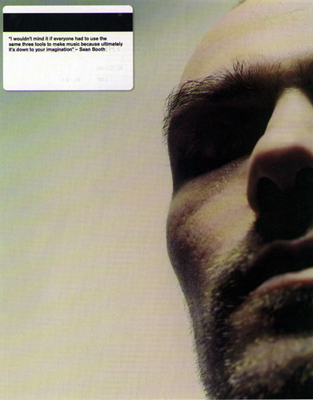
Booth reprises, "I wouldn't mind if everyone had to use the same three tools
to make music because ultimately it's down to your imagination."
The accusation of complacency also implies that Autechre are oblivious to
the rest of the contemporary musical universe, that their reluctance to allow
outside influences to permeate their sound implies indifference, even contempt
towards their peers. However, they're manifestly steeped in modern sounds,
their tastes reflected in their curated line-up of this month's UK branch
of the All Tomorrow's Parties festival.
"It was smart getting asked to do All Tomorrow's Parties," says Booth. "It's
an opportunity to put something on that we would have no choice but to go
to. The wish list was easy. We've found as it's been booked that loads of
the artists are into quite a lot of the other artists. It should make for
some good music. We're looking forward to seeing Curtis Roads and Mark E Smith
in the same place."
The line-up also includes fellow Warp travelers like The Aphex Twin and LFO,
as well as mavericks and pioneers like A Guy Called Gerald, Cannibal Ox and
avant garde perennials :zoviet*france: - "I like the way they imply music,"
enthuses Booth. Veteran French electronic composer Bernard Parmegiani is also
slated to appear in the unlikely setting of ATP's campsite, amid the crazy
golf, beach activities and go-karting. However, Booth's pairing of The Fall's
Mark E Smith and digital music pioneer Curtis Roads is apposite. Roads's exploration
of granular synthesis (published last year in a hefty volume called Microsound,
by MIT Press) represents a different, academic approach to electronics from
Autechre's, but there are shared interests there too. They're both, for example,
immersed in electronic music that operates at a subatomic level. The Fall's
Mancunian contrarian obstreperousness, however, is also a key component of
Autechre's make-up. Strange but strangely logical are the forces that propelled
Autechre to where they're at today.
Brought up in the northern English town of Rochdale, Sean Booth was acquainted
very early on with the joys of mixing and taping. "When I was really young
I heard "Revolution No 9" by The Beatles," he recalls. "I used to love Sergeant
Pepper and Pet Sounds. I didn't know the first thing about making records.
And my dad told me all about multitrack tape recorders. He'd got it into his
head that The Beatles were the first ever group to use multitrack tape recorders.
I was given my first tape recorder at 11 and taught how to do edits and stuff
- so I knew about editing tape. I'd record stuff off TV and do funny little
vocal edits but I wasn't trying to make music or anything."
Picking up on the electro-funk scene inaugurated in 1982 by the likes of
Afrika Bambaataa, Booth ran with a 'tagging' crew, making his mark around
Rochdale with his own brand of graffiti art. "I did that for three or four
years," he relates, "achieved a really obscure, peer-based notoriety and then
got bored. Tagging was just a social thing, at a time when I was too young
to get into clubs. But I could meet my peer group. If you're tagging buses,
you might tag 30 buses a day but the only people who take any notice are other
taggers, so you really are marking out territory.”
The parallels between tagging and Autechre’s later musical approach are not
so far fetched keeping a step ahead, compulsive creativity for its own sake,
outdoing the already done. A meaningless pursuit, maybe - but not a mindless
one. Booth denies that he was indulging in mere juvenile delinquency, drawing
this distinction: "The worst thing for a tagger is a smashed up bus shelter,"
he states. "You're waiting for a bus, not only are you getting wet through
because there's no windows but you can't tag either. There's nothing worse
than real, property-destroying vandals. "
By 1984, he was hanging round funk import shops in Manchester like Spinning.
"It was the first time I'd been in a shop where virtually everyone was black
and everyone was taller than me. I was a freak for going in there, living
where I was, no one I knew went in there." Brown, meanwhile, was making up
tapes of early HipHop like Run DMC and Man Parrish's "HipHop Be-Bop (Don't
Stop)" and "Boogie Down Bronx". "I eventually bought the originals," he says,
"but ended up preferring the tapes I grew up on, even if they were second
or third generation versions, because it was etched into me that way."
Introduced by a mutual friend, Booth and Brown immediately struck up the
symbiotic, almost telepathic relationship that exists to this day. The wordshapes
they began to use as titles for their pieces from the mid-90s onwards are
culled from a sort of private language between the two of them.
"We don't discuss the music in conventional terms," says Booth. "It's a case
of presenting each other with musical ideas and seeing if the other likes
them, or if they've got a better idea. We're brutally co-operative. We're
all over each other's works. The first time we collaborated, I took a tape
round to Rob's and he did a hatchet job on it. But we were fairly synchronised
to begin with, so that was OK."
"And we've known each other a long enough time to be honest," adds Brown.
"We couldn't get away with not being honest any more. We can tell from each
other's tones of voices..."
If Autechre were conceived in a moment of epiphany, it was when they listened
to the Mantronix megamixes and found themselves drawn to the lightning-fast
edits and remixes of The Latin Rascals and Chep Nunez. The essence of these
records, they discovered, was in the treatments. "We were always waiting for
those bits and we were always thinking, it'd be great if music was like this
all the way through, this cut-up," recalls Booth.
With the brutalist minimalism of HipHop, the sleek sheets of sound emanating
from Detroit and those Mantronix megamixes still bouncing around the house,
the 1980s were glad times for the teenage Booth and Brown. But things were
about to go awry. "I got really annoyed when De La Soul came along in 1989,"
groans Booth, "and everyone said how brilliant it was. But I just thought,
how lame is that? You sample some white music and suddenly you're cool? It's
the only way a black guy can get any sort of success these days. They were
loved by the indie press when they came out but I thought 3 Feet High And
Rising was a low point. It was really up itself. Plus my mate Ged met them
in Manchester and they were cunts to him."
Another problem was in seeking out British HipHop role models. "We didn't
have any major commercial examples to follow," says Booth. "British HipHop
was hung up with the idea of authenticity, which tended to mean American-sounding.
It was daft, you were chasing something you couldn't have."
They took some solace in the likes of Meat Beat Manifesto and Renegade Soundwave,
although retrospectively, I suggest, they were at the tired, tail end of the
Industrial funk noir aesthetic of groups like Cabaret Voltaire and Chakk.
"But precursors to the denim, as Happy Mondays and Stone Roses flooded the
scene and the airwaves, drowning out all competing local musical possibilities.
"it was a party we weren't invited to," remembers Brown.
And so the spurned pair took to their bedrooms. "I suppose we were given
the opportunity to fester in our own space, keep in a really small circle,
outside of the big volcano that was Manchester in the late 80s," reflects
Brown. With the burgeoning Acid House grooves burbling through their headphones,
however, they bided their time. Their first musical efforts met with the sort
of befuddlement Autechre have had to get used to from certain quarters over
the years.
"We'd take stuff into [Manchester independent record store] Eastern Bloc
and they'd just stand there, looking confused, saying, 'What is this?"' says
Booth.
"I think with our music it was a case of 'Keep it to yourself, guys'," expands
Brown. "We had loads of people telling us not to bother because it was a bit
odd. It wouldn't have worked in a HipHop context." But look at [British] groups
like Hijack and Gunshot, the hard time they were having. And they were major
full-on HipHop bands."
Hardcore became the catalyst for Autechre, as Booth attests. "It was part
of what we grew up on," he continues. "Clubs like Conspiracy, Thunderdog in
1990, 1991 - they were proper, dark Hardcore clubs... that was the start of
Jungle, hearing breaks starting to be cut imaginatively. I know Jungle, drum
In' bass, the press scene started coming in about 1994 - but a lot of the
electronics kids had already been there, you know, Aphex and people like that,
before they'd worked out what category it was supposed to be in. Our first
release [1992's "Cavity Job"] was on a Hardcore label, a proper Hardcore 12"
played on pirate radio. We had to make it, really, in order to get a deal,
we had to make a balls-out Hardcore track. The B side was a bit more adventurous
but that's why it was the B side."
Following a nightmare deal with a small independent label, Autechre took
the seemingly unlikely step of approaching Warp in Sheffield. If today, Autechre
are emblematic of the label, back then it was principally home to LFO and
Nightmares On Wax. Their first real exposure came with Warp's Artificial Intelligence
compilation in 1992, which included the likes of The Orb's Dr Alex Paterson,
Speedy J, Black Dog and The Aphex Twin, under various aliases. These artists
thrived in the 'comedown' zone that prevailed as Efuelled partygoers chilled
in the haze of the dawn. Autechre realised they were part of such a movement,
making music aimed as much, if not more, at the head as at the limbs. "We
were all completely unaware of each other," Brown points out, "but we realised
how much had in common." And their sound was still relatively organic, albeit
bolstered by what Brown calls "massive samples", as their Al contributions
"The Egg" and "Crystel" showed.
Autechre's earlier albums - Incunabula (1993) and Amber (1994) - were terrific
adventures in homebrewed Techno but not radically dissimilar in method from
the work of their Warp contemporaries. With each subsequent release, however,
they took an increasingly remote turn, moving away from both the blissful
pastures of the chill out zone and the wildfire, staple gun rhythms characteristic
of the 'Intelligent Dance Music' brigade. The Anti EP was a rare show of solidarity
with the dance scene, a piece of musical satire against the 1994 Criminal
Justice Bill and its risible injunction against "repetitive beats". That was
the last time Autechre were 'about' something.
By 1997's Chiastic Slide, their sound had taken on an increasingly disorientated,
even mechanistic approach - "I'm quite into the idea of engineering was never
any ou t at rown an oot were oing all the work - not the machines. With each
successive release, they tested both their own curiosity and that of their
fans, culminating in 2001's Confield, their most exacting, micro-surgical
album to date.
Confield provided the blueprint for their latest work, Draft 7.30. It feels
more fluid, accessible and shapely than its predecessor. Still, with its crunched
and shredded textures, arrhythmic beats, the hothouse ping of particle bombardment,
and amplified recordings of millipedes shuffling across glass, the music's
impact is astonishing. There's an almost claustrophobic sense that Autechre
are pawing and scratching at the very outer edges of what's possible, as if
the known musical universe is as constricting as a chrysalis: you're struck
by the sheer minuteness of detail. Like the Incredible Shrinking Man, you
can make out the very molecular structures of these sonic surroundings. Listening
to it on headphones, you're aware of tracks like "Xylin Room" tunneling through
the nethermost regions of your cerebellum, beavering away to unclog the wormholes
of the imagination.
Draft 7.30 has its less extreme interludes. On "Theme Of Sudden Roundabout",
you can just about make out faintly recognisable shapes. There are passages
of film noir-ish tension but also an intimation of light and warmth filtering
through its metal thickets. Autechre are one of the few groups to have emerged
from the Techno/dance world whose music approaches the experimental regions
of musique concrete. Yet there are recognisable loops and recurrences, a certain
feverishness which dispels any air of scientific or academic aridity in their
work and betrays their dance roots. Whereas some concrete composers leave
you with a lingering feeling of bubbling test tubes and algebraic equations,
with Autechre there's a bristle, a buzz. You can imagine them at work, on
the balls of their feet, surrounded by piles of old HipHop 12" singles, brewing
up these sonic storms and going mental as Scissorhands with the editing.
As for the duo themselves, their reflections on Draft 7.30 are vague and
hesitant. "It feels a bit more open again," offers Brown, while Booth adds,
"It's not thrust in a particular direction." The downside for Autechre is
how the 'openness' of their sound allows for contradictory reactions. Like
anyone else, they're eager for feedback even as they're sometimes dismayed
at the lack of consensus.
"Every time we have an album out, we get conflicting reports," despairs Brown.
"There's one strain of opinion, then another one comes in reinforced numbers.
Mostly, we'd been hearing that this one was more accessible than Confield.
But then someone comes along and fucks it all up and tells us that they think
it's the coldest, hardest work we've ever done. 'Confield was so warm, what
are you up to?"'
"We've had it all," sighs Booth. "More accessible, less accessible, cleaner,
dirtier... In the end, you get completely confused. It's like, what does the
world think? It's just snap judgments. It does take our music a few weeks
to sink in."
Unlike many in the world of electronic music who are hard pressed and ill-equipped
to convert their soundlab experiments into some show of creative work being
done, Autechre thrive playing live. For them, it isn't just a case of pushing
a bit of software into a machine and pressing the On button. Their live shows
are spontaneous creative affairs, done on the fly, each freshly minted permutation
of sound, rhythm and texture expiring in the moment of its creation. As Booth
once said, "The only music that's really futurist is that which hasn't been
created yet." They generally insist on playing in near complete darkness,
again to minimize unwanted visual associations and focus concentration entirely
on the quicksilver motions of the music burrowing deep inside your head. Autechre
have even talked about achieving telepathic communion with audiences.
"In a club the ideas don't get a chance to be edited out, so what you're
getting is much more raw," says Booth. "I don't want to go off on one about
emotion or the subconscious, but there's obviously a different cognitive process
going on. It's the same as when we jam in the studio, really, that's what
got us doing it in the first place. Loads of the tracks we were doing back
when we started were unedited live recordings, we just thought it would be
good to take that way of working outside. At All Tomorrow's Parties we'll
be working as Gescom [Autechre's alter-ego project, involving a crew of anything
up to 20 people], which is great because it's always different people, so
it's challenging and liberating at the same time. It's about the most unroutine
Organisation we've ever been a part of."
Born in 1970 and 1972 respectively, Brown and Booth were just too young to
catch the first wave of electropop which it's presently so fashionable to
simulate. They were toddlers when Kraftwerk arrived on the scene. They came
upon most of their futurist ancestors retrospectively, and their attitudes
towards them are not always reverential. As one of the surprisingly few contemporary
electronic acts who sound like they've docked in, or at least sniffed around
the space stations established by the 50s electronic pioneers, what do they
make of the likes of Stockhausen, et al?
"We first heard Stockhausen in 1991," frowns Booth. "But I didn't really
click with it until I heard Tod Dockstader a few years later. Stockhausen
fell foul of his own theories really, really quickly, I think. He's done three,
maybe four works... Kontakte, Gesang Der Jtjnglinge among them - but compared
to Stockhausen, Tod Dockstader felt very soulful, more fat and warm. I do
rate Kontakte, the original two-track tape, not the one with extra percussion
and piano, that is. We didn't think about concrete for years, didn't really
know what it was. But then when I understood what serialism was about, and
this antirhythmic stance it took, I went cold on it. It seemed just as bad
as people taking a purely rhythmic stance. It was like, I'm anti-you and now
I'm stuck here.
"A lot of composers from that era talk so much crap," he spits. "Ligeti and
Xenakis from that era are my favourites, I suppose and Tod Dockstader. Also
Edgard Varese - Po6me Electronique in particular."
Autechre reject academic dogma, but they're not anti-intellectual. Booth
praises the fractal nature of contemporary pirate radio, its permanent, relentless
outlaw stream of new and freshly recycled beats providing a contemporary backdrop
to Autechre's own work. Needless to say, they deplore the tyrannical homogeneity
of mainstream dance music.
"I understand it," he concedes. "When you're listening to music with a fixed
structure, say basic verse and chorus, it's all about catharsis and anticipation.
The loop changes, you're in a new loop, you assess the loop, then your brain
relaxes for a few bars, till just before the next change when you start paying
a bit more attention, getting a bit more hyped up and then you capitalise
on that. It's tension/release, tension/release. I don't like films that are
predictable and I don't like music that's predictable. I don't need that kind
of security. There are so many possible permutations, so many types of music,
so many things that you'd expect music to be more varied. It stands to reason."
Draft 7.30 is out this month on Warp. All Tomorrow's Parties takes place
4-6 April see Out There and www.atpfestival.com
Originally appeared in The Wire, April 2003. Copyright © The Wire
«
|
|


|