|
|
This is the sound of ...Autechre
There are times music can be so insidiously alien to the ears that
its mere presence can be startling. The 'foreigness' of the sound is
both brutal and fragile, or - yet all the more beautifully beckoning
because of it.
Born nine years ago through a natural love of electro, hip-hop and
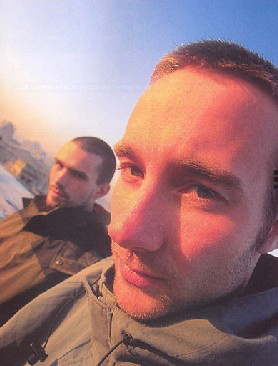
graffiti art, Sean Booth and Rob Brown are Autechre. They first
surfaced on the now legendary Artificial Intelligence compilation
released on the respected UK label Warp, in 1992. The next year saw
the release of their first album, Incunabula, followed in 1994 by
the beautiful, critically-acclaimed, Amber. Now, 1996 brings the
third full-length release, Tri Repetae, to the ears of America. This
is definitely not happy, hippie, floaty ambient - rather a harsh
cinematic sounds cape full of edgy paranoia, bleakness, and moments
of clear beauty. In other words, typical Autechre...but was this the
plan when they started? "We never really got started," says Booth,
the band's unofficial spokesman, "We just kinda ended up doing this.
We'd both been into electro for years when we met in '87... had
almost identical record collections. In fact, the records we didn't
have in common were the ones we both wanted!" So how do two blokes
from Northern England come up with such strange, thoughtprovoking
sonic landscapes? "You tell me, man," quips Booth, "It's just what
we like to do."
 With time that can, of course, change, and there
have been slight sonic shifts quite evident in Autechre's sound. For
where Incunabula is clearly rounded and ordered, Amber sounds both
barren and lush - a spooky, yet beautiful sweep set against a
stainless steel groove. The new album meanwhile, is darker, colder -
a bleak, melodic flow sliding against harsher, industrial
percussives. The changes, however slight, beg the question: are they
conscious with each release, and is there some meaning to be culled
from the music itself? "We're following it, not directing it
anywhere," says Booth, "We really don't see the albums themselves as
being a cohesive whole or a collection of tracks - to us they're
both. We consider what we do to be quite considered, yet intuitive;
but what we'd call intuitive, someone else might call completely
constructed. Everything's relative really."
With time that can, of course, change, and there
have been slight sonic shifts quite evident in Autechre's sound. For
where Incunabula is clearly rounded and ordered, Amber sounds both
barren and lush - a spooky, yet beautiful sweep set against a
stainless steel groove. The new album meanwhile, is darker, colder -
a bleak, melodic flow sliding against harsher, industrial
percussives. The changes, however slight, beg the question: are they
conscious with each release, and is there some meaning to be culled
from the music itself? "We're following it, not directing it
anywhere," says Booth, "We really don't see the albums themselves as
being a cohesive whole or a collection of tracks - to us they're
both. We consider what we do to be quite considered, yet intuitive;
but what we'd call intuitive, someone else might call completely
constructed. Everything's relative really."
Just like the manner in
which Autechre's music is itself conveniently labeled as
"intelligent techno" or "post-ambient"; genre definitions which, at
the end of the day, mean something different to everyone. Do Booth
and Brown find this annoying, or... "If you would've asked us that
three years ago we'd have said we fucking hate it," says Booth. "It
doesn't bother us anymore though. I think we're used to the fact
that there will be another genre to replace the one you were a part
of six months ago, especially in the UK." Brown adds, "We hate using
them [genre buzzwords], and hate that they exist, but music is so
different from words, so inexpressible, that journalists basically
need these words to describe [music] to other people. We consider
our music to be all types - it just depends on what we felt like
doing in the studio that day."
Think of any media-created buzzword
and you have instant marketing potential for that music. With the
recent explosion of releases that could be called "trip hop" or
"jungle," more and more "musicians" seem to be chasing after sales
with a readily adaptable sound - does this bandwagon-jumping have
any effect on Autechre? "There's a lot of people trying to keep up
with whatever the press are on about," says Brown, "But that's
always been something quite separate from what we do. We don't care
about that; we just want to sell records." "Anyway," asks Booth,
"It's pretty much a waste of time, isn't it?" He adds, "Besides,
what constitutes a jungle track is almost definitely defined by the
genre itself-with our music we're not confined by so many rules.
There are no rules for Autechre, we basically apply different rules
whenever we see fit. That's what music is all about-imposing rules
on yourself." Does this mean a strict sense of critical control over
what's released, or does anything go-as it
often seems to with some artists in the field of electronic music?
"But," says Brown pointedly, "That's basically saying 'fuck the
industry,' isn't it?" "It's all philosophical bollocks at the end of
the day," chimes Booth. "We just make music to entertain people!
Yes, that and to make a living; something which shouldn't cause fans
to accuse bands of "selling out" so often - after all, all of us
have to eat, don't we? Which is why, even for bands like Autechre,
sales, promotional tours and interviewing, not to mention radio
airplay are all extremely important. Basically, if we're not making
enough money off the music then we'll do something else. We need
money so that we can still make music!"
Making music is the key here
this is, after all is said, what is most important to Autechre.
Playing live, as they did on their recent US tour, is somt:,hir;g
they enjoy. So is going to clubs, although they're not into the club
"scene" itself. "We go to clubs because there's music there," says
Booth. "I mean... I like the sound systems being loud, and being
able to dance with loads of other people - it's all brilliant
really. But, at the same time, its the music we love more than
anything." Does the band see any differences between audiences in
the states and those in their homeland? "It's difficult to compare,"
says Booth. "We've been really surprised how well things have gone
[on the US tour]. Last time we came, there were lots of big clubs
with just a few people into it. This time the clubs tend to be
smaller, but there's more people into the music. The fringe people,
who were into it just because it was from Europe, are gone. It's a
much healthier scene now." Yet, with the obvious technological
limitations and hurdles, it becomes extremely difficult, if not
daunting, to stage a live show for artists such as Autechre. How do
they pull it off? "It's a simple use of equipment," explains Booth,
"with a huge amount of sequences." "Basically," adds Brown, "We jam
with whatever raw material we've got." Booth elaborates: "Rob has a
lot of the melody sequences and I have the rhythm sequences, and we
playoff each other. We don't actually play the instruments - we just
determine what happens when. [Live] the sound becomes more suited to
whatever the night is. [For example] if there's been loads of
banging club music, its gonna follow in that vein. Whatever goes on
before we play will affect our sound slightly - that always
happens."
As does the consumption of many illegal substances that
seem to have a home not only with club-goers, but with many of the
artists themselves. Does Autechre have an opinion about the place of
drugs in the "scene"? "Everybody has got a different attitude to
drugs," says Brown, "But they're a fact and we really can't have an
opinion on them because they exist." "I think," adds Booth, "They're
as relevant as breathing and as irrelevant as the music." Which, in
the end, just goes to further illustrate how perplexing and
enigmatic Autechre can be - two traits not easily swallowed by
American consumers. Do the band feel a need to help people along by
including some sort of narrative within the music - like vocals,
maybe? "Our music might follow a narrative within the music - but it
surely isn't a literal one," states Booth. "It doesn't define things
too sharply, and we don't see a point at the moment in making things
too, perhaps... confined." "Although," adds Brown, "We've always
used vocal sounds, as opposed to words in our music, but..." Booth
continues, "We basically haven't got the means to do exactly what we
want with vocals yet. Maybe we'll do it in the future, maybe not."
With their experimental side project, Gescom, (check out the
recently released EP, The Sound of Machines our Parents Used, on the
electro label, Clear) their demand as remixers (everyone from Saint
Etienne, DJ Food and Scorn have been treated), to projects on their
own label, Skam (at least two will be releases in the next twelve
months), their future sure looks to be busy. Just how long do they
expect Autechre to last? "Until we're dead," deadpans Booth.
"Actually it's in the realm of increasing possibilities, because we
know what we're doing. I'd like to think we'll be doing it for a
while. All we want is to make music that has some longevity, that
people can listen to again and again." Well, so far, so good.
Raymond Hovey
Originally appeared in Resonance, Issue 6 1996. Copyright © Resonance
«
|
|

|