|
|
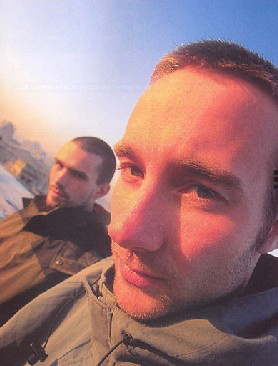
Autechre. 1999
When I picked up the phone from my Detroit studio, I answer to a think British
accent, one that I can't quite place with my mid-west ears.
It is actually a Manchester twang, more specifically an accent straight out of
city called Sheffield, located a few hours north of Londn. Sheffield, England is an industrial town
much like Detroit, it happens to baost a collective of well know electronic musicians...
...Arguably, the duo Autechre is amongst the most
talked about in recent months. Twenty-six year old Sean Booth is one
half of the group that the media can't quite put a finger on.
During our conversation we talk about the usual stuff, like the
weather, the great Michigan snowstorm of '99 ("Ahh shit you're up
north as well," he says) and Autechre's recent fascination with
trees. He's calling me from his studio. Rob Brown', the other half of
Autechre, is in the background, presumably tinkering with gear, while
Sean fields my question. Sean is blunt to the point and definitely
not hesitant to talk about what's on his mind.
Maybe he is frank because Autechre has attracted all kinds of quirky
commentary, as one DJ put it, riding on "a thin line between stupid
and clever" or as one writer put it, "visceral yet rhythmically
complex, melodic yet otherworldly." Autechre have compiled a prolific
set of albums in the past few years, including, Incunablula, Tri
Repetae, Autechre and the Peel Sessions, released last February. So
far, experimental might be the best label for their music. "I think
that genres are obviously like totally hilarious," Sean says.
With the myriad of responses to Autechre's schizophrenic rhythms,
it's safe to say that their music qualifies as unique, which is one
of their aspirations, Sean says. "We're just trying to be different
and not like that's the only reason we exist, but in terms of being
artists and being on the same label. You've got strive to be
yourself. It's trying to stand on the right side of the line."
In their quest for artistic innovation, Autechre has steadily
gathered a devoted fan base, but success did not come as a shock to
Sean.
 "As a kid, I really thought I could do it," he says. "I knew that it
could take leaps and bound. It was really encouraging. We were well
into hip hop. It was kind of like we just knew there were people who
were going to be into what we are doing."
Sean and Rob joined forces over a decade ago, sharing a
fondness for hip hop and Juan Atkins. "We didn't know what the
connections were at the time. To me it was like a good acid record
was as good as Juan Atkins doing a good electro record. There was a
time where it was all the same thing. Now there's 20 genre names for
hip hop that shouldn't even be there." The music scene in Sheffield
was a big local influence, but they paid particular attention to
trail blazing Detroit music. "Mike Banks, loads of UR, Red Planet, all
Derrick May Carl Craig. We've got loads of Direct Beat. It's major
part of out intellect," Sean says of his influences.
Sean and Rob joined forces in 1987, sharing musical taste, a
creative bond, common friends, and for a time, the same living space.
"It's difficult, I mean we do spend a lot of time working together."
Yet, their friendship hasn't gotten in the way of their music, Sean
says, "because we both know what we should do."
"I think everybody has different inclinations. I think Rob
and I help each other guide things in a certain direction," he says.
"There is generally a fifty-fifty split between the amount of work
that goes into a track." Their approach has garnished them some
unexpected attention, from the likes of Nine Inch Nails kingpin,
Trent Resnor, who also picked up Squarepusher, another Sheffield
producer and Warp Records recording artist, for Nothing.
"We reckon its hilarious. It's really interesting working with him.
It's a learning exercise as much as anything," Sean says of Resnor.
"I don't know what's going to happen with it. It 's a long time going and
it's like after that, whatever, if someone comes along and offers you
a ridiculous amount of money. It's much more than we needed, but it's
like it's turned out really useful because we've managed to get
everything going." They've also attracted attention from the Sony
Japan powerhouse. "I don't have any qualms about taking money from
these people," he adds. "Yeah, as you said, we're lucky as fuck.."
After considerable success in breakthrough world markets,
Autechre is hungry to keep going, spending 12 to 15 hours a day in
their studio.
They listen to records at all times of the day, like most
musician types, staying up all night working out tracks until dawn.
"We're used to getting up here early as well. I was getting up at 3
in the morning or 4 in the morning. Then its like you feel you have a
personal life."
"As a kid, I really thought I could do it," he says. "I knew that it
could take leaps and bound. It was really encouraging. We were well
into hip hop. It was kind of like we just knew there were people who
were going to be into what we are doing."
Sean and Rob joined forces over a decade ago, sharing a
fondness for hip hop and Juan Atkins. "We didn't know what the
connections were at the time. To me it was like a good acid record
was as good as Juan Atkins doing a good electro record. There was a
time where it was all the same thing. Now there's 20 genre names for
hip hop that shouldn't even be there." The music scene in Sheffield
was a big local influence, but they paid particular attention to
trail blazing Detroit music. "Mike Banks, loads of UR, Red Planet, all
Derrick May Carl Craig. We've got loads of Direct Beat. It's major
part of out intellect," Sean says of his influences.
Sean and Rob joined forces in 1987, sharing musical taste, a
creative bond, common friends, and for a time, the same living space.
"It's difficult, I mean we do spend a lot of time working together."
Yet, their friendship hasn't gotten in the way of their music, Sean
says, "because we both know what we should do."
"I think everybody has different inclinations. I think Rob
and I help each other guide things in a certain direction," he says.
"There is generally a fifty-fifty split between the amount of work
that goes into a track." Their approach has garnished them some
unexpected attention, from the likes of Nine Inch Nails kingpin,
Trent Resnor, who also picked up Squarepusher, another Sheffield
producer and Warp Records recording artist, for Nothing.
"We reckon its hilarious. It's really interesting working with him.
It's a learning exercise as much as anything," Sean says of Resnor.
"I don't know what's going to happen with it. It 's a long time going and
it's like after that, whatever, if someone comes along and offers you
a ridiculous amount of money. It's much more than we needed, but it's
like it's turned out really useful because we've managed to get
everything going." They've also attracted attention from the Sony
Japan powerhouse. "I don't have any qualms about taking money from
these people," he adds. "Yeah, as you said, we're lucky as fuck.."
After considerable success in breakthrough world markets,
Autechre is hungry to keep going, spending 12 to 15 hours a day in
their studio.
They listen to records at all times of the day, like most
musician types, staying up all night working out tracks until dawn.
"We're used to getting up here early as well. I was getting up at 3
in the morning or 4 in the morning. Then its like you feel you have a
personal life."
For Sean, time in the studio is crucial."I think if you give yourself
time to develop you start finding things out," he says.. "I think its
well worthwhile spending more time, maybe than is necessary."
But is the young group getting burned out by the demands placed on
them by the media or their label? It does not seem to be the case.
"Our main problem is getting the ideas down, because we have too
many," Sean says. "Every track we do sounds different from the last
one anyway. Occasionally there's period where you find yourself doing
similar tracks."
They generally devote more time to creating new music than to
promoting and performing. ""We do have a booking agent, she calls us
every few days. We'd rather be working," he says. "We haven't done
any gigs for like 8 months. We're going to do more, obviously."
(Summer's a better time for touring, I say. "No, he answers, "all the
best club nights, all the best stuff goes on in winter." Okay, I
speculated wrongly.)
Part of the reason, Sean and Rob maintain discipline is that
they are able to actually focus on creating new music on a full-time
basis.
"We've got a mate who's got a label and he's real trustworthy. We
don't have to run a label for ourselves which is pretty lucky really,
quite a luxury. Running a label is very stressful. Like seriously,
you've got to know what you're doing. If you're trying to make music,
I think you're stronger doing what you're doing."
So maybe it's their success that has inspired them to keep
going, but again I am wrong. Sean makes it clear, they do it for
themselves.
"I might consider like, a person. I don't consider like, a
thousand people. You can't consider 20,000 people who are into the
sort of things we're into, he says. "You can't really reach out with
people. We don't really make an effort to try. That's not really the
sort of people we are. We want people to feel good. I just don't know
if we do it the same as everyone else."
So they let their guts guide their music. "I think its important to
do whatever you feel it is you have to do. If you feel like you
should do 50 different types of records, then you should do that."
At the end of the day, like true musicians, Autechre has what
they set out to do, to make the music they want to hear. "That's what
its there for. When I listen to tracks from ten years ago, I find so
much out about myself that I just would never would have known at
that age."
So in their unforeseen path to stardom, Autechre opts for the
Underground ideology.
"We're just never going to compromise what we do musically. It's the
only thing that will remain solid, what we do, no matter what
happens."
So back to the trees. Trees and Autechre. Sean sums up the connection
in his own words. Hmm, a guy who doesn't hold back..
I've just been getting into trees recently, the way that a tree
branches - decisions, splits. I love Oak trees. The most amazing thing
about plants is that they don't ever get old; they 're so much better
than animals." Tamara Warren
Originally appeared at Famzine, 1999.
Copyright © Tamara Warren
«
|
|

|